Papa King’s Notes — Reading the Data, Testing the Facts, Demanding Answers
TANJUNG SELOR, MJ — The management of regional government cash by the Provincial Government of North Kalimantan, particularly funds earmarked for specific purposes, has come under scrutiny by the Audit Board of Indonesia (BPK) in its audit of the 2025 Regional Government Financial Statements. BPK found that the issuance of Fund Disbursement Orders did not fully take into account the source of funds, but instead focused more on cash availability.
The issue concerns the financial control function of the Regional Financial and Asset Management Agency (BKAD), in its capacity as the Regional General Treasurer (BUD), as well as the role of the Regional Secretary, who serves as Chair of the Regional Government Budget Team (TAPD), in ensuring that funding sources are properly tagged in expenditure budgets.
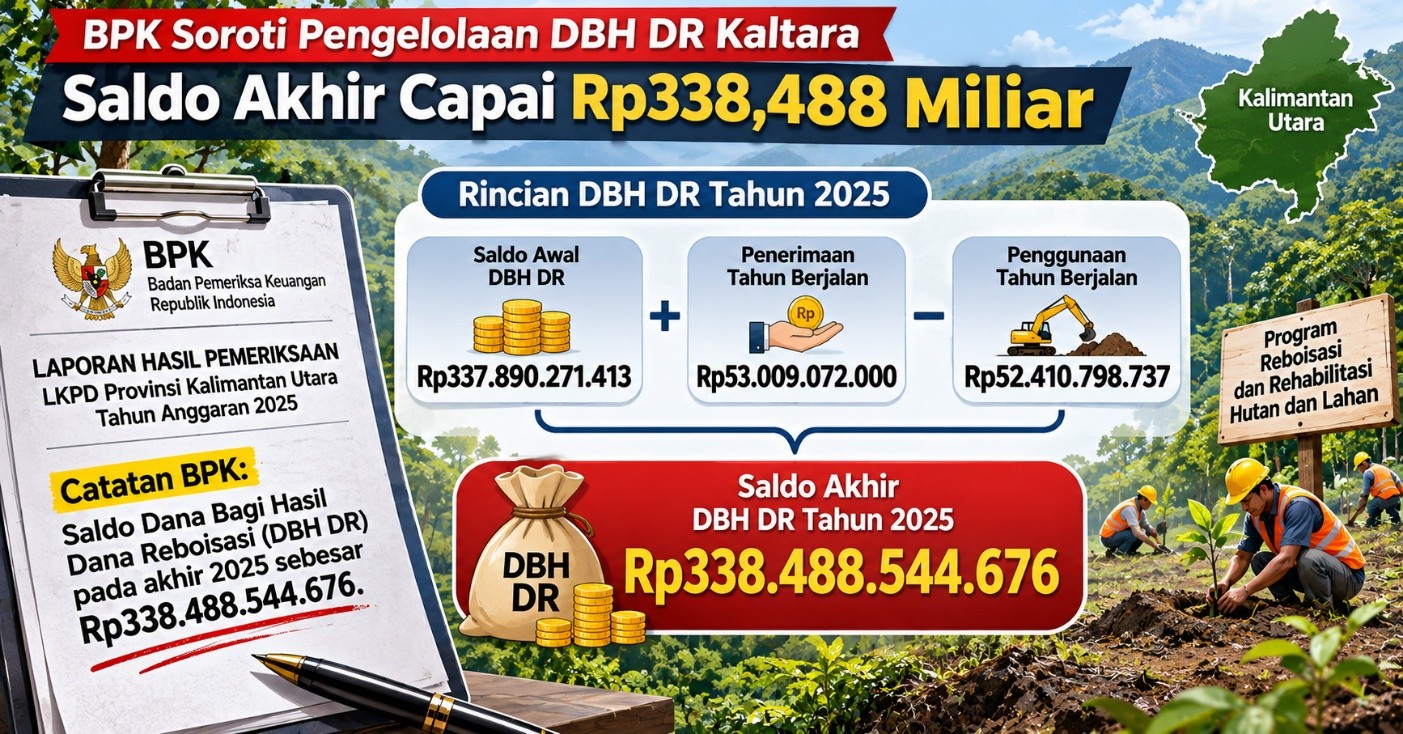
According to the audit documents, BPK recorded the closing balance of the Revenue Sharing Fund from Reforestation at the end of 2025 at IDR 338,488,544,676. This figure comprised an opening balance of IDR 337,890,271,413, revenue received during the year of IDR 53,009,072,000, and expenditure amounting to IDR 52,410,798,737.
Consequently, the DBH DR balance increased by IDR 598,273,263 compared with the opening balance. The DBH DR is earmarked for specific purposes, including reforestation, forest and land rehabilitation, and other related activities.
BPK also identified issues in the management of earmarked funds. One section of the audit findings stated that the balance of this category of funds in 2025 reached IDR 607,862,434,732. Meanwhile, the detailed table in the financial report presented a different aggregate figure after balance adjustments were taken into account. The regional government needs to explain this discrepancy so that the balances and composition of each funding source can be consistently traced.
BPK revealed that the Authorized Regional General Treasurer had attempted to implement funding-source tagging through manual working papers. However, this mechanism had not been effective. One of the obstacles was the inconsistency between funding-source tags in the Regional Budget (APBD) and its amendments , and the revenue projections intended to finance the activities.
Furthermore, in 2025, the Regional Government Information System (SIPD) application did not yet have an automatic blocking feature for activity accounts that, in substance, no longer had available funding sources. As a result, registered Payment Request Letters (SPM) still had to be processed for the issuance of SP2D.
BPK’s audit also found that the Regional General Treasurer had not conducted daily monitoring of cash availability according to each funding source. This condition hindered adjustments to cash-planning documents, such as the Fund Availability Letter (SPD) and the Cash Budget Plan (RAK), to ensure they reflected actual funding availability.
In response to these issues, BPK recommended that the Governor of North Kalimantan instruct the Regional Secretary, as Chair of the TAPD, to ensure that funding sources are tagged in accordance with applicable regulations. The Head of BKAD, in their capacity as BUD, was instructed to strengthen cash controls based on funding sources, while the Authorized Regional General Treasurer was required to process disbursements in accordance with the rules governing the use of earmarked funds.
These findings raise several questions about regional budgetary controls. How many SP2Ds were issued without adequate verification of their funding sources? Which activities used cash from different funding sources? What progress has been made in implementing BPK’s recommendations, particularly regarding the DBH DR balance, which stood at IDR 338.48 billion?
Further investigation requires access to the APBD and APBD-P funding-source tagging documents, the list of SP2Ds, cash records classified by funding source, SPD, RAK, and reports on DBH DR utilization by regional government agency.
Until these issues can be explained through adequate documentation, the findings should be treated as concerns relating to regional cash control and financial governance. There is currently insufficient basis to conclude that the DBH DR balance has been misappropriated.
INVESTIGATION CODE: MJ-INV-KALTARA-2026
NEWS CODE: MJ-PPK-KALTARA-2026-001
© 04-11-2026 Mediajakarta.co.id. All rights reserved.