Catatan Papa King
Reading the Data, Testing the Facts, Demanding Answers
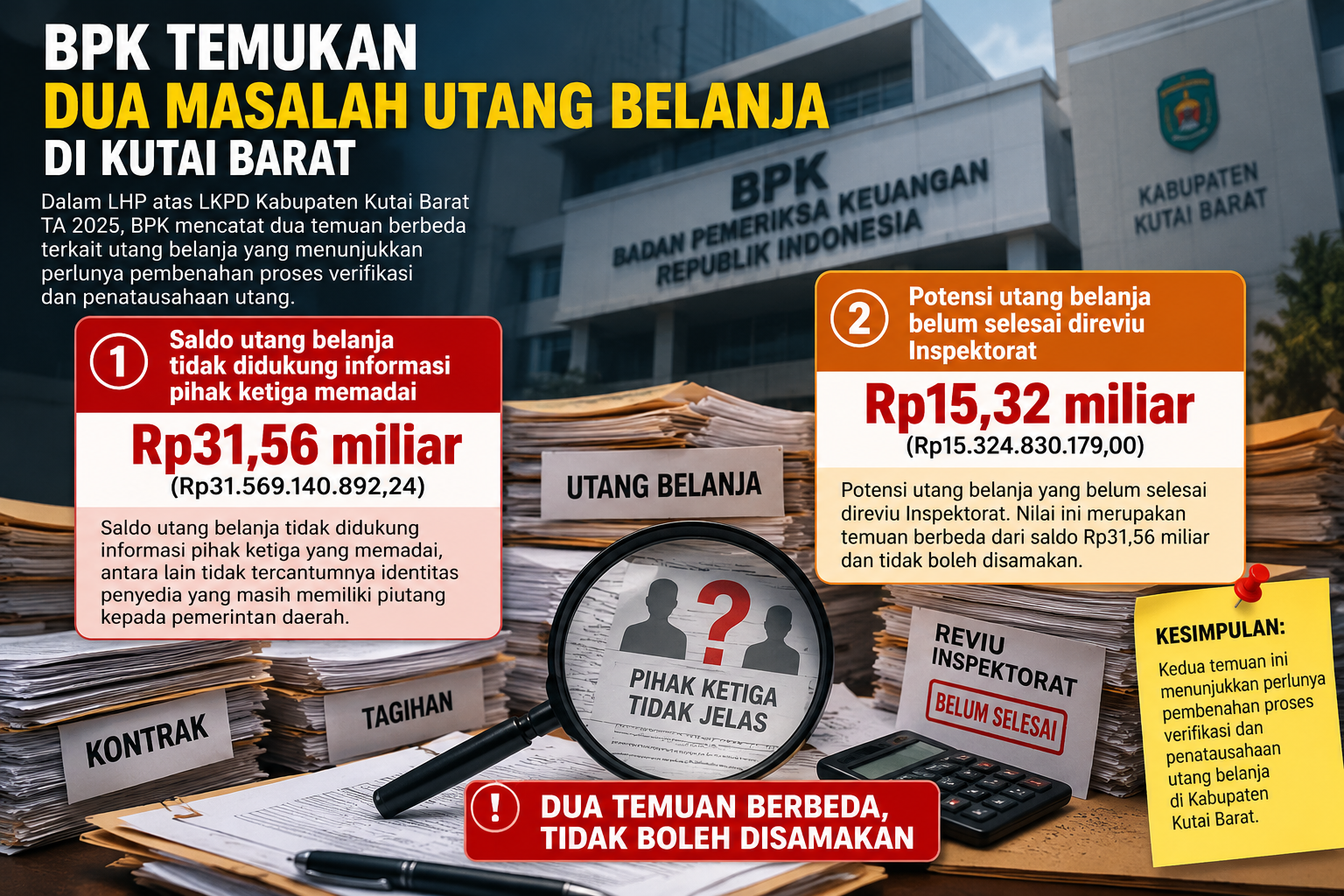
WEST KUTAI, MJ — The management of expenditure payables by the West Kutai Regency Government has come under scrutiny once again. In its Audit Report (LHP) on the West Kutai Regency Government’s Financial Statements for Fiscal Year 2025, the Audit Board of Indonesia (BPK) found approximately Rp31.56 billion in recorded expenditure payables that it considered unreliable because they were not supported by adequate third-party information.
The finding goes beyond a mere issue of recording figures in financial statements. According to the audit, documentation deficiencies included the absence of information identifying suppliers who were still owed money by the regional government. This condition makes it difficult to establish which parties are legally entitled to receive payment for the recorded liabilities.
BPK reported that its sample-based examination of payable records, physical and financial realization reports, and supporting accountability documents identified 68 work packages that were not adequately supported by contracts and other relevant documentation. Details of these payables are presented in Appendix I.47 of the BPK Audit Report.
According to the explanation recorded by the auditors, the Treasury Division of the Regional Finance and Asset Agency (BKAD) stated that the relevant agencies, including the Public Works and Spatial Planning Agency (DPUPR), had attempted to verify the work packages recorded as outstanding liabilities. However, the available details and supporting documents were considered inadequate. It was also reported that some liabilities had been recorded for more than five years and could no longer be traced further.
BPK linked these problems to the failure of the Inspectorate and the Head of BKAD to adequately update and validate payable data. In addition, several relevant regional government agencies (OPDs) had not prepared subsidiary ledgers of expenditure payables for each work package as an official control mechanism. Verification by the Head of the Treasury Division of proposed liability recognition was also deemed inadequate.
From the perspective of regional financial accountability, the findings raise a fundamental question: how can the accuracy of a government liability, its contractual basis, and the identity of its recipient be established when supporting documents are incomplete? This question must be answered through document tracing and verification, rather than by immediately concluding that irregularities or state financial losses have occurred.
BPK also recorded a separate issue: potential expenditure payables amounting to Rp15,324,830,179, or approximately Rp15.32 billion, had not yet completed the Inspectorate’s review process. This amount represents a different finding from the Rp31.56 billion in payables that lacked adequate third-party information. The two figures must not be conflated. Both findings, however, point to the need to improve verification procedures and the administration of outstanding liabilities.
BPK’s finding concerning unreliable payable balances represents a serious issue in regional financial governance. Nevertheless, the finding does not, by itself, establish that the entire Rp31.56 billion constitutes fictitious debt or a loss to the state. The documents that need to be disclosed and verified include the underlying records for each work package, creditor identities, the status of each liability, and the follow-up actions taken in response to BPK’s recommendations. This is where the accountability of the regional government will be tested.
INVESTIGATION CODE: MJ-INV-Kubar-r-2026
NEWS CODE: MJ-PPK-Kubar-2026-001
© 2026 Mediajakarta.co.id. All rights reserved.